EMT Practice Test

1. Question Content...


Question List

Question1: Your company is selecting a system to centralize data ingestion and delivery. You are considering messaging and data integration systems to address the requirements. The key requirements are:
The ability to seek to a particular offset in a topic, possibly back to the start of all data ever captured Support for publish/subscribe semantics on hundreds of topics Retain per-key ordering Which system should you choose?

Question2: Which Cloud Dataflow / Beam feature should you use to aggregate data in an unbounded data source every hour based on the time when the data entered the pipeline?

Question3: You need ads data to serve Al models and historical data tor analytics longtail and outlier data points need to be identified You want to cleanse the data n near-reel time before running it through Al models What should you do?

Question4: Cloud Bigtable is Google's ______ Big Data database service.

Question5: Flowlogistic's CEO wants to gain rapid insight into their customer base so his sales team can be better informed in the field. This team is not very technical, so they've purchased a visualization tool to simplify the creation of BigQuery reports. However, they've been overwhelmed by all the data in the table, and are spending a lot of money on queries trying to find the data they need. You want to solve their problem in the most cost-effective way. What should you do?

Question6: You need to copy millions of sensitive patient records from a relational database to BigQuery. The total size of the database is 10 TB. You need to design a solution that is secure and time-efficient. What should you do?

Question7: You are migrating your on-premises data warehouse to BigQuery. One of the upstream data sources resides on a MySQL database that runs in your on-premises data center with no public IP addresses. You want to ensure that the data ingestion into BigQuery is done securely and does not go through the public internet. What should you do?

Question8: You work for a manufacturing company that sources up to 750 different components, each from a different supplier. You've collected a labeled dataset that has on average 1000 examples for each unique component. Your team wants to implement an app to help warehouse workers recognize incoming components based on a photo of the component. You want to implement the first working version of this app (as Proof-Of-Concept) within a few working days. What should you do?

Question9: You need to choose a database to store time series CPU and memory usage for millions of computers. You need to store this data in one-second interval samples. Analysts will be performing real-time, ad hoc analytics against the database. You want to avoid being charged for every query executed and ensure that the schema design will allow for future growth of the dataset. Which database and data model should you choose?

Question10: Your neural network model is taking days to train. You want to increase the training speed. What can you do?

Question11: You want to use a BigQuery table as a data sink. In which writing mode(s) can you use BigQuery as a sink?

Question12: You are running your BigQuery project in the on-demand billing model and are executing a change data capture (CDC) process that ingests dat a. The CDC process loads 1 GB of data every 10 minutes into a temporary table, and then performs a merge into a 10 TB target table. This process is very scan intensive and you want to explore options to enable a predictable cost model. You need to create a BigQuery reservation based on utilization information gathered from BigQuery Monitoring and apply the reservation to the CDC process. What should you do?

Question13: An external customer provides you with a daily dump of data from their database. The data flows into Google Cloud Storage GCS as comma-separated values (CSV) files. You want to analyze this data in Google BigQuery, but the data could have rows that are formatted incorrectly or corrupted. How should you build this pipeline?

Question14: After migrating ETL jobs to run on BigQuery, you need to verify that the output of the migrated jobs is the same as the output of the original. You've loaded a table containing the output of the original job and want to compare the contents with output from the migrated job to show that they are identical. The tables do not contain a primary key column that would enable you to join them together for comparison.
What should you do?

Question15: What are two of the benefits of using denormalized data structures in BigQuery?

Question16: You are administering a BigQuery dataset that uses a customer-managed encryption key (CMEK). You need to share the dataset with a partner organization that does not have access to your CMEK. What should you do?

Question17: Cloud Dataproc is a managed Apache Hadoop and Apache _____ service.

Question18: You work for a mid-sized enterprise that needs to move its operational system transaction data from an on-premises database to GCP. The database is about 20 TB in size. Which database should you choose?

Question19: You are updating the code for a subscriber to a Put/Sub feed. You are concerned that upon deployment the subscriber may erroneously acknowledge messages, leading to message loss. You subscriber is not set up to retain acknowledged messages. What should you do to ensure that you can recover from errors after deployment?

Question20: You're training a model to predict housing prices based on an available dataset with real estate properties. Your plan is to train a fully connected neural net, and you've discovered that the dataset contains latitude and longtitude of the property. Real estate professionals have told you that the location of the property is highly influential on price, so you'd like to engineer a feature that incorporates this physical dependency.
What should you do?

Question21: You work for a shipping company that uses handheld scanners to read shipping labels. Your company has strict data privacy standards that require scanners to only transmit recipients' personally identifiable information (PII) to analytics systems, which violates user privacy rules. You want to quickly build a scalable solution using cloud-native managed services to prevent exposure of PII to the analytics systems. What should you do?

Question22: You have a data pipeline with a Cloud Dataflow job that aggregates and writes time series metrics to Cloud Bigtable. This data feeds a dashboard used by thousands of users across the organization. You need to support additional concurrent users and reduce the amount of time required to write the data. Which two actions should you take? (Choose two.)

Question23: Your company's customer_order table in BigOuery stores the order history for 10 million customers, with a table size of 10 PB. You need to create a dashboard for the support team to view the order history. The dashboard has two filters, countryname and username. Both are string data types in the BigQuery table. When a filter is applied, the dashboard fetches the order history from the table and displays the query results. However, the dashboard is slow to show the results when applying the filters to the following query:

How should you redesign the BigQuery table to support faster access?

Question24: Cloud Bigtable is a recommended option for storing very large amounts of ____________________________?

Question25: Which of the following statements about the Wide & Deep Learning model are true? (Select 2 answers.)

Question26: You launched a new gaming app almost three years ago. You have been uploading log files from the previous day to a separate Google BigQuery table with the table name format LOGS_yyyymmdd. You have been using table wildcard functions to generate daily and monthly reports for all time ranges. Recently, you discovered that some queries that cover long date ranges are exceeding the limit of 1,000 tables and failing. How can you resolve this issue?

Question27: You are architecting a data transformation solution for BigQuery. Your developers are proficient with SOL and want to use the ELT development technique. In addition, your developers need an intuitive coding environment and the ability to manage SQL as code. You need to identify a solution for your developers to build these pipelines. What should you do?

Question28: You are building a report-only data warehouse where the data is streamed into BigQuery via the streaming API Following Google's best practices, you have both a staging and a production table for the data How should you design your data loading to ensure that there is only one master dataset without affecting performance on either the ingestion or reporting pieces?

Question29: You need to create a data pipeline that copies time-series transaction data so that it can be queried from within BigQuery by your data science team for analysis. Every hour, thousands of transactions are updated with a new status. The size of the intitial dataset is 1.5 PB, and it will grow by 3 TB per day. The data is heavily structured, and your data science team will build machine learning models based on this dat a. You want to maximize performance and usability for your data science team. Which two strategies should you adopt? Choose 2 answers.

Question30: Which SQL keyword can be used to reduce the number of columns processed by BigQuery?

Question31: Your chemical company needs to manually check documentation for customer order. You use a pull subscription in Pub/Sub so that sales agents get details from the order. You must ensure that you do not process orders twice with different sales agents and that you do not add more complexity to this workflow. What should you do?

Question32: Your company is loading comma-separated values (CSV) files into Google BigQuery. The data is fully imported successfully; however, the imported data is not matching byte-to-byte to the source file. What is the most likely cause of this problem?

Question33: You need to migrate a Redis database from an on-premises data center to a Memorystore for Redis instance. You want to follow Google-recommended practices and perform the migration for minimal cost. time, and effort. What should you do?

Question34: The YARN ResourceManager and the HDFS NameNode interfaces are available on a Cloud Dataproc cluster ____.

Question35: You are building a teal-lime prediction engine that streams files, which may contain Pll (personal identifiable information) data, into Cloud Storage and eventually into BigQuery You want to ensure that the sensitive data is masked but still maintains referential Integrity, because names and emails are often used as join keys How should you use the Cloud Data Loss Prevention API (DLP API) to ensure that the Pll data is not accessible by unauthorized individuals?

Question36: Which of the following is NOT one of the three main types of triggers that Dataflow supports?

Question37: How would you query specific partitions in a BigQuery table?

Question38: Your company is implementing a data warehouse using BigQuery, and you have been tasked with designing the data model You move your on-premises sales data warehouse with a star data schema to BigQuery but notice performance issues when querying the data of the past 30 days Based on Google's recommended practices, what should you do to speed up the query without increasing storage costs?

Question39: You are working on a sensitive project involving private user dat
a. You have set up a project on Google Cloud Platform to house your work internally. An external consultant is going to assist with coding a complex transformation in a Google Cloud Dataflow pipeline for your project. How should you maintain users' privacy?

Question40: Suppose you have a dataset of images that are each labeled as to whether or not they contain a human face. To create a neural network that recognizes human faces in images using this labeled dataset, what approach would likely be the most effective?

Question41: You create an important report for your large team in Google Data Studio 360. The report uses Google BigQuery as its data source. You notice that visualizations are not showing data that is less than 1 hour old. What should you do?

Question42: Which of the following statements is NOT true regarding Bigtable access roles?

Question43: You are designing a fault-tolerant architecture to store data in a regional BigOuery dataset. You need to ensure that your application is able to recover from a corruption event in your tables that occurred within the past seven days. You want to adopt managed services with the lowest RPO and most cost-effective solution. What should you do?

Question44: You work for a large fast food restaurant chain with over 400,000 employees. You store employee information in Google BigQuery in a Userstable consisting of a FirstNamefield and a LastNamefield. A member of IT is building an application and asks you to modify the schema and data in BigQuery so the application can query a FullNamefield consisting of the value of the FirstNamefield concatenated with a space, followed by the value of the LastNamefield for each employee. How can you make that data available while minimizing cost?

Question45: You are deploying MariaDB SQL databases on GCE VM Instances and need to configure monitoring and alerting. You want to collect metrics including network connections, disk IO and replication status from MariaDB with minimal development effort and use StackDriver for dashboards and alerts.
What should you do?

Question46: You are designing a data mesh on Google Cloud with multiple distinct data engineering teams building data products. The typical data curation design pattern consists of landing files in Cloud Storage, transforming raw data in Cloud Storage and BigQuery datasets. and storing the final curated data product in BigQuery datasets You need to configure Dataplex to ensure that each team can access only the assets needed to build their data products. You also need to ensure that teams can easily share the curated data product. What should you do?

Question47: You are planning to use Cloud Storage as pad of your data lake solution. The Cloud Storage bucket will contain objects ingested from external systems. Each object will be ingested once, and the access patterns of individual objects will be random. You want to minimize the cost of storing and retrieving these objects. You want to ensure that any cost optimization efforts are transparent to the users and applications. What should you do?

Question48: You designed a database for patient records as a pilot project to cover a few hundred patients in three clinics. Your design used a single database table to represent all patients and their visits, and you used self-joins to generate reports. The server resource utilization was at 50%. Since then, the scope of the project has expanded. The database must now store 100 times more patient records. You can no longer run the reports, because they either take too long or they encounter errors with insufficient compute resources. How should you adjust the database design?

Question49: You currently use a SQL-based tool to visualize your data stored in BigQuery The data visualizations require the use of outer joins and analytic functions. Visualizations must be based on data that is no less than 4 hours old. Business users are complaining that the visualizations are too slow to generate. You want to improve the performance of the visualization queries while minimizing the maintenance overhead of the data preparation pipeline. What should you do?

Question50: Your company is migrating its on-premises data warehousing solution to BigQuery. The existing data warehouse uses trigger-based change data capture (CDC) to apply daily updates from transactional database sources Your company wants to use BigQuery to improve its handling of CDC and to optimize the performance of the data warehouse Source system changes must be available for query m near-real time using tog-based CDC streams You need to ensure that changes in the BigQuery reporting table are available with minimal latency and reduced overhead. What should you do? Choose 2 answers

Question51: Your company is migrating their 30-node Apache Hadoop cluster to the cloud. They want to re-use Hadoop jobs they have already created and minimize the management of the cluster as much as possible. They also want to be able to persist data beyond the life of the cluster. What should you do?

Question52: You are building an application to share financial market data with consumers, who will receive data feeds. Data is collected from the markets in real time. Consumers will receive the data in the following ways:
Real-time event stream
ANSI SQL access to real-time stream and historical data
Batch historical exports
Which solution should you use?

Question53: You have data pipelines running on BigQuery, Cloud Dataflow, and Cloud Dataproc. You need to perform health checks and monitor their behavior, and then notify the team managing the pipelines if they fail. You also need to be able to work across multiple projects. Your preference is to use managed products of features of the platform. What should you do?

Question54: You are building a model to make clothing recommendations. You know a user's fashion preference is likely to change over time, so you build a data pipeline to stream new data back to the model as it becomes available. How should you use this data to train the model?

Question55: You want to migrate an on-premises Hadoop system to Cloud Dataproc. Hive is the primary tool in use, and the data format is Optimized Row Columnar (ORC). All ORC files have been successfully copied to a Cloud Storage bucket. You need to replicate some data to the cluster's local Hadoop Distributed File System (HDFS) to maximize performance. What are two ways to start using Hive in Cloud Dataproc? (Choose two.)

Question56: You are designing storage for two relational tables that are part of a 10-TB database on Google Cloud. You want to support transactions that scale horizontally. You also want to optimize data for range queries on nonkey columns. What should you do?

Question57: What are all of the BigQuery operations that Google charges for?

Question58: You operate an IoT pipeline built around Apache Kafka that normally receives around 5000 messages per second. You want to use Google Cloud Platform to create an alert as soon as the moving average over 1 hour drops below 4000 messages per second. What should you do?

Question59: You need to migrate a 2TB relational database to Google Cloud Platform. You do not have the resources to significantly refactor the application that uses this database and cost to operate is of primary concern.
Which service do you select for storing and serving your data?

Question60: You are planning to use Google's Dataflow SDK to analyze customer data such as displayed below. Your project requirement is to extract only the customer name from the data source and then write to an output PCollection.
Tom,555 X street
Tim,553 Y street
Sam, 111 Z street
Which operation is best suited for the above data processing requirement?

Question61: A web server sends click events to a Pub/Sub topic as messages. The web server includes an event Timestamp attribute in the messages, which is the time when the click occurred. You have a Dataflow streaming job that reads from this Pub/Sub topic through a subscription, applies some transformations, and writes the result to another Pub/Sub topic for use by the advertising department. The advertising department needs to receive each message within 30 seconds of the corresponding click occurrence, but they report receiving the messages late. Your Dataflow job's system lag is about 5 seconds, and the data freshness is about 40 seconds. Inspecting a few messages show no more than 1 second lag between their event Timestamp and publish Time. What is the problem and what should you do?

Question62: You have a query that filters a BigQuery table using a WHERE clause on timestamp and ID columns. By using bq query - -dry_run you learn that the query triggers a full scan of the table, even though the filter on timestamp and ID select a tiny fraction of the overall data. You want to reduce the amount of data scanned by BigQuery with minimal changes to existing SQL queries. What should you do?

Question63: You need to look at BigQuery data from a specific table multiple times a day. The underlying table you are querying is several petabytes in size, but you want to filter your data and provide simple aggregations to downstream users. You want to run queries faster and get up-to-date insights quicker. What should you do?

Question64: Which of these is NOT a way to customize the software on Dataproc cluster instances?

Question65: You migrated your on-premises Apache Hadoop Distributed File System (HDFS) data lake to Cloud Storage. The data scientist team needs to process the data by using Apache Spark and SQL. Security policies need to be enforced at the column level. You need a cost-effective solution that can scale into a data mesh. What should you do?

Question66: You have a BigQuery table that ingests data directly from a Pub/Sub subscription. The ingested data is encrypted with a Google-managed encryption key. You need to meet a new organization policy that requires you to use keys from a centralized Cloud Key Management Service (Cloud KMS) project to encrypt data at rest. What should you do?

Question67: You want to automate execution of a multi-step data pipeline running on Google Cloud. The pipeline includes Cloud Dataproc and Cloud Dataflow jobs that have multiple dependencies on each other. You want to use managed services where possible, and the pipeline will run every day. Which tool should you use?

Question68: You are designing a data mesh on Google Cloud by using Dataplex to manage data in BigQuery and Cloud Storage. You want to simplify data asset permissions. You are creating a customer virtual lake with two user groups:
* Data engineers, which require lull data lake access
* Analytic users, which require access to curated data
You need to assign access rights to these two groups. What should you do?

Question69: You are developing a new deep teaming model that predicts a customer's likelihood to buy on your ecommerce site. Alter running an evaluation of the model against both the original training data and new test data, you find that your model is overfitting the dat a. You want to improve the accuracy of the model when predicting new data. What should you do?

Question70: You have 100 GB of data stored in a BigQuery table. This data is outdated and will only be accessed one or two times a year for analytics with SQL. For backup purposes, you want to store this data to be immutable for 3 years. You want to minimize storage costs. What should you do?

Question71: You are integrating one of your internal IT applications and Google BigQuery, so users can query BigQuery from the application's interface. You do not want individual users to authenticate to BigQuery and you do not want to give them access to the dataset. You need to securely access BigQuery from your IT application.
What should you do?

Question72: You have a data stored in BigQuery. The data in the BigQuery dataset must be highly available. You need to define a storage, backup, and recovery strategy of this data that minimizes cost. How should you configure the BigQuery table?

Question73: The data analyst team at your company uses BigQuery for ad-hoc queries and scheduled SQL pipelines in a Google Cloud project with a slot reservation of 2000 slots. However, with the recent introduction of hundreds of new non time-sensitive SQL pipelines, the team is encountering frequent quota errors. You examine the logs and notice that approximately 1500 queries are being triggered concurrently during peak time. You need to resolve the concurrency issue. What should you do?

Question74: You have a requirement to insert minute-resolution data from 50,000 sensors into a BigQuery table. You expect significant growth in data volume and need the data to be available within 1 minute of ingestion for real-time analysis of aggregated trends. What should you do?

Question75: Cloud Dataproc charges you only for what you really use with _____ billing.

Question76: You have thousands of Apache Spark jobs running in your on-premises Apache Hadoop cluster. You want to migrate the jobs to Google Cloud. You want to use managed services to run your jobs instead of maintaining a long-lived Hadoop cluster yourself. You have a tight timeline and want to keep code changes to a minimum. What should you do?

Question77: By default, which of the following windowing behavior does Dataflow apply to unbounded data sets?

Question78: You are preparing an organization-wide dataset. You need to preprocess customer data stored in a restricted bucket in Cloud Storage. The data will be used to create consumer analyses. You need to follow data privacy requirements, including protecting certain sensitive data elements, while also retaining all of the data for potential future use cases. What should you do?

Question79: You operate a logistics company, and you want to improve event delivery reliability for vehicle-based sensors. You operate small data centers around the world to capture these events, but leased lines that provide connectivity from your event collection infrastructure to your event processing infrastructure are unreliable, with unpredictable latency. You want to address this issue in the most cost-effective way. What should you do?

Question80: To give a user read permission for only the first three columns of a table, which access control method would you use?

Question81: You want to build a managed Hadoop system as your data lake. The data transformation process is composed of a series of Hadoop jobs executed in sequence. To accomplish the design of separating storage from compute, you decided to use the Cloud Storage connector to store all input data, output data, and intermediary data. However, you noticed that one Hadoop job runs very slowly with Cloud Dataproc, when compared with the on-premises bare-metal Hadoop environment (8-core nodes with 100-GB RAM). Analysis shows that this particular Hadoop job is disk I/O intensive. You want to resolve the issue. What should you do?

Question82: When creating a new Cloud Dataproc cluster with the projects.regions.clusters.create operation, these four values are required: project, region, name, and ____.

Question83: You are designing the database schema for a machine learning-based food ordering service that will predict what users want to eat. Here is some of the information you need to store:
* The user profile: What the user likes and doesn't like to eat
* The user account information: Name, address, preferred meal times
* The order information: When orders are made, from where, to whom
The database will be used to store all the transactional data of the product. You want to optimize the data schema. Which Google Cloud Platform product should you use?

Question84: Government regulations in your industry mandate that you have to maintain an auditable record of access to certain types of datA. Assuming that all expiring logs will be archived correctly, where should you store data that is subject to that mandate?

Question85: Which of these sources can you not load data into BigQuery from?

Question86: MJTelco's Google Cloud Dataflow pipeline is now ready to start receiving data from the 50,000 installations. You want to allow Cloud Dataflow to scale its compute power up as required. Which Cloud Dataflow pipeline configuration setting should you update?

Question87: What are two of the characteristics of using online prediction rather than batch prediction?

Question88: You are a BigQuery admin supporting a team of data consumers who run ad hoc queries and downstream reporting in tools such as Looker. All data and users are combined under a single organizational project. You recently noticed some slowness in query results and want to troubleshoot where the slowdowns are occurring. You think that there might be some job queuing or slot contention occurring as users run jobs, which slows down access to results. You need to investigate the query job information and determine where performance is being affected. What should you do?

Question89: When a Cloud Bigtable node fails, ____ is lost.

Question90: Why do you need to split a machine learning dataset into training data and test data?

Question91: If a dataset contains rows with individual people and columns for year of birth, country, and income, how many of the columns are continuous and how many are categorical?

Question92: Which of the following job types are supported by Cloud Dataproc (select 3 answers)?
Question93: You need (o give new website users a globally unique identifier (GUID) using a service that takes in data points and returns a GUID This data is sourced from both internal and external systems via HTTP calls that you will make via microservices within your pipeline There will be tens of thousands of messages per second and that can be multithreaded, and you worry about the backpressure on the system How should you design your pipeline to minimize that backpressure?

Question94: You need to deploy additional dependencies to all of a Cloud Dataproc cluster at startup using an existing initialization action. Company security policies require that Cloud Dataproc nodes do not have access to the Internet so public initialization actions cannot fetch resources. What should you do?

Question95: Which TensorFlow function can you use to configure a categorical column if you don't know all of the possible values for that column?

Question96: Different teams in your organization store customer and performance data in BigOuery. Each team needs to keep full control of their collected data, be able to query data within their projects, and be able to exchange their data with other teams. You need to implement an organization-wide solution, while minimizing operational tasks and costs. What should you do?

Question97: Your organization is modernizing their IT services and migrating to Google Cloud. You need to organize the data that will be stored in Cloud Storage and BigQuery. You need to enable a data mesh approach to share the data between sales, product design, and marketing departments What should you do?

Question98: Your organization uses a multi-cloud data storage strategy, storing data in Cloud Storage, and data in Amazon Web Services' (AWS) S3 storage buckets. All data resides in US regions. You want to query up-to-date data by using BigQuery. regardless of which cloud the data is stored in. You need to allow users to query the tables from BigQuery without giving direct access to the data in the storage buckets What should you do?

Question99: You are designing a Dataflow pipeline for a batch processing job. You want to mitigate multiple zonal failures at job submission time. What should you do?

Question100: You have uploaded 5 years of log data to Cloud Storage A user reported that some data points in the log data are outside of their expected ranges, which indicates errors You need to address this issue and be able to run the process again in the future while keeping the original data for compliance reasons. What should you do?

Question101: To run a TensorFlow training job on your own computer using Cloud Machine Learning Engine, what would your command start with?

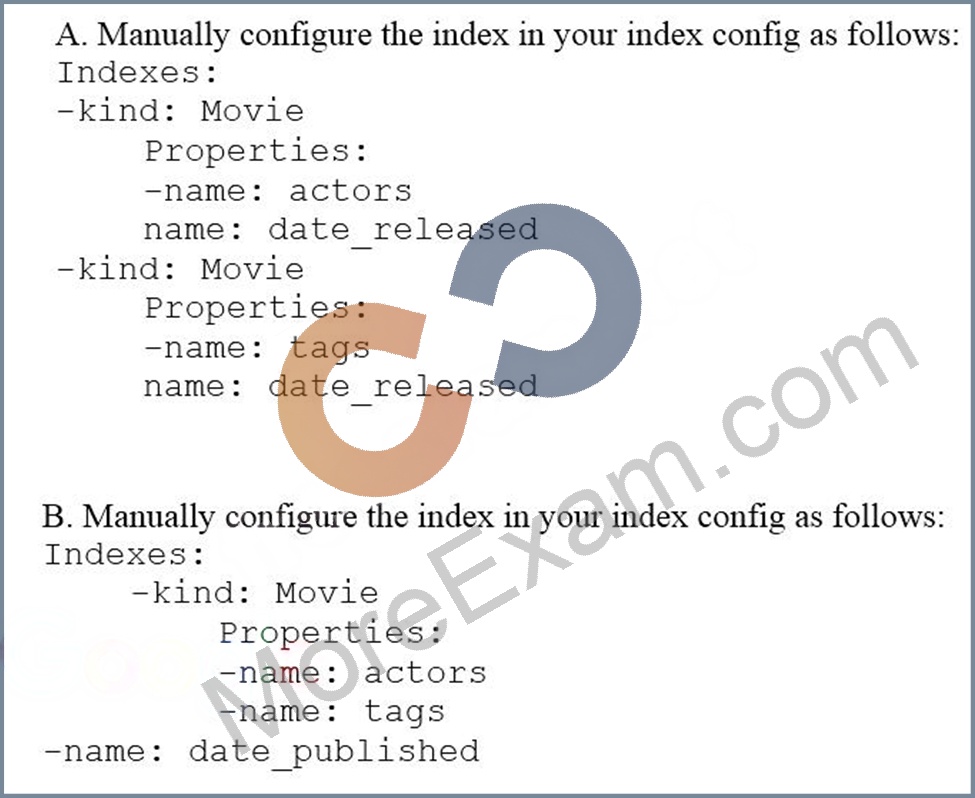
Question102: You are deploying a new storage system for your mobile application, which is a media streaming service. You decide the best fit is Google Cloud Datastore. You have entities with multiple properties, some of which can take on multiple values. For example, in the entity 'Movie' the property 'actors' and the property 'tags' have multiple values but the property 'date released' does not. A typical query would ask for all movies with actor=<actorname> ordered by date_released or all movies with tag=Comedy ordered by date_released. How should you avoid a combinatorial explosion in the number of indexes?

Question103: You are running a pipeline in Cloud Dataflow that receives messages from a Cloud Pub/Sub topic and writes the results to a BigQuery dataset in the EU. Currently, your pipeline is located in europe-west4 and has a maximum of 3 workers, instance type n1-standard-1. You notice that during peak periods, your pipeline is struggling to process records in a timely fashion, when all 3 workers are at maximum CPU utilization. Which two actions can you take to increase performance of your pipeline? (Choose two.)

Question104: Which of the following is NOT true about Dataflow pipelines?

Question105: You have developed three data processing jobs. One executes a Cloud Dataflow pipeline that transforms data uploaded to Cloud Storage and writes results to BigQuery. The second ingests data from on- premises servers and uploads it to Cloud Storage. The third is a Cloud Dataflow pipeline that gets information from third-party data providers and uploads the information to Cloud Storage. You need to be able to schedule and monitor the execution of these three workflows and manually execute them when needed. What should you do?

Question106: Each analytics team in your organization is running BigQuery jobs in their own projects. You want to enable each team to monitor slot usage within their projects. What should you do?

Question107: Which of the following is NOT a valid use case to select HDD (hard disk drives) as the storage for Google Cloud Bigtable?

Question108: Your infrastructure team has set up an interconnect link between Google Cloud and the on-premises network. You are designing a high-throughput streaming pipeline to ingest data in streaming from an Apache Kafka cluster hosted on-premises. You want to store the data in BigQuery, with as minima! latency as possible. What should you do?

Question109: You are designing storage for very large text files for a data pipeline on Google Cloud. You want to support ANSI SQL queries. You also want to support compression and parallel load from the input locations using Google recommended practices. What should you do?

Question110: Your company's on-premises Apache Hadoop servers are approaching end-of-life, and IT has decided to migrate the cluster to Google Cloud Dataproc. A like-for-like migration of the cluster would require 50 TB of Google Persistent Disk per node. The CIO is concerned about the cost of using that much block storage. You want to minimize the storage cost of the migration. What should you do?

Question111: You are deploying 10,000 new Internet of Things devices to collect temperature data in your warehouses globally. You need to process, store and analyze these very large datasets in real time. What should you do?

Question112: When using Cloud Dataproc clusters, you can access the YARN web interface by configuring a browser to connect through a ____ proxy.

Question113: You are administering shared BigQuery datasets that contain views used by multiple teams in your organization. The marketing team is concerned about the variability of their monthly BigQuery analytics spend using the on-demand billing model. You need to help the marketing team establish a consistent BigQuery analytics spend each month. What should you do?

Question114: You need to choose a database for a new project that has the following requirements:
* Fully managed
* Able to automatically scale up
* Transactionally consistent
* Able to scale up to 6 TB
* Able to be queried using SQL
Which database do you choose?

Question115: When you store data in Cloud Bigtable, what is the recommended minimum amount of stored data?

Question116: You are implementing a chatbot to help an online retailer streamline their customer service. The chatbot must be able to respond to both text and voice inquiries. You are looking for a low-code or no-code option, and you want to be able to easily train the chatbot to provide answers to keywords. What should you do?

Question117: You are creating the CI'CD cycle for the code of the directed acyclic graphs (DAGs) running in Cloud Composer. Your team has two Cloud Composer instances: one instance for development and another instance for production. Your team is using a Git repository to maintain and develop the code of the DAGs. You want to deploy the DAGs automatically to Cloud Composer when a certain tag is pushed to the Git repository. What should you do?

Question118: Your company operates in three domains: airlines, hotels, and ride-hailing services. Each domain has two teams: analytics and data science, which create data assets in BigQuery with the help of a central data platform team. However, as each domain is evolving rapidly, the central data platform team is becoming a bottleneck. This is causing delays in deriving insights from data, and resulting in stale data when pipelines are not kept up to date. You need to design a data mesh architecture by using Dataplex to eliminate the bottleneck. What should you do?

Question119: You have a petabyte of analytics data and need to design a storage and processing platform for it. You must be able to perform data warehouse-style analytics on the data in Google Cloud and expose the dataset as files for batch analysis tools in other cloud providers. What should you do?

Question120: Which is the preferred method to use to avoid hotspotting in time series data in Bigtable?

Question121: You have two projects where you run BigQuery jobs:
* One project runs production jobs that have strict completion time SLAs. These are high priority jobs that must have the required compute resources available when needed. These jobs generally never go below a 300 slot utilization, but occasionally spike up an additional 500 slots.
* The other project is for users to run ad-hoc analytical queries. This project generally never uses more than 200 slots at a time. You want these ad-hoc queries to be billed based on how much data users scan rather than by slot capacity.
You need to ensure that both projects have the appropriate compute resources available. What should you do?

Question122: You are loading CSV files from Cloud Storage to BigQuery. The files have known data quality issues, including mismatched data types, such as STRINGS and INT64s in the same column, and inconsistent formatting of values such as phone numbers or addresses. You need to create the data pipeline to maintain data quality and perform the required cleansing and transformation. What should you do?

Question123: If you want to create a machine learning model that predicts the price of a particular stock based on its recent price history, what type of estimator should you use?

Question124: Your company maintains a hybrid deployment with GCP, where analytics are performed on your anonymized customer data. The data are imported to Cloud Storage from your data center through parallel uploads to a data transfer server running on GCP. Management informs you that the daily transfers take too long and have asked you to fix the problem. You want to maximize transfer speeds. Which action should you take?

Question125: An online brokerage company requires a high volume trade processing architecture. You need to create a secure queuing system that triggers jobs. The jobs will run in Google Cloud and cat the company's Python API to execute trades. You need to efficiently implement a solution. What should you do?

Question126: You work for a large ecommerce company. You are using Pub/Sub to ingest the clickstream data to Google Cloud for analytics. You observe that when a new subscriber connects to an existing topic to analyze data, they are unable to subscribe to older data for an upcoming yearly sale event in two months, you need a solution that, once implemented, will enable any new subscriber to read the last 30 days of dat a. What should you do?

Question127: You are operating a Cloud Dataflow streaming pipeline. The pipeline aggregates events from a Cloud Pub/Sub subscription source, within a window, and sinks the resulting aggregation to a Cloud Storage bucket. The source has consistent throughput. You want to monitor an alert on behavior of the pipeline with Cloud Stackdriver to ensure that it is processing data. Which Stackdriver alerts should you create?

Question128: The Development and External teams nave the project viewer Identity and Access Management (1AM) role m a folder named Visualization. You want the Development Team to be able to read data from both Cloud Storage and BigQuery, but the External Team should only be able to read data from BigQuery. What should you do?

Question129: You have Cloud Functions written in Node.js that pull messages from Cloud Pub/Sub and send the data to BigQuery. You observe that the message processing rate on the Pub/Sub topic is orders of magnitude higher than anticipated, but there is no error logged in Stackdriver Log Viewer. What are the two most likely causes of this problem? Choose 2 answers.

Question130: You are using Cloud Bigtable to persist and serve stock market data for each of the major indices. To serve the trading application, you need to access only the most recent stock prices that are streaming in How should you design your row key and tables to ensure that you can access the data with the most simple query?

Question131: You need to store and analyze social media postings in Google BigQuery at a rate of 10,000 messages per minute in near real-time. Initially, design the application to use streaming inserts for individual postings. Your application also performs data aggregations right after the streaming inserts. You discover that the queries after streaming inserts do not exhibit strong consistency, and reports from the queries might miss in-flight dat a. How can you adjust your application design?

Question132: Which of the following are examples of hyperparameters? (Select 2 answers.)

Question133: You need to move 2 PB of historical data from an on-premises storage appliance to Cloud Storage within six months, and your outbound network capacity is constrained to 20 Mb/sec. How should you migrate this data to Cloud Storage?

Question134: You are designing a messaging system by using Pub/Sub to process clickstream data with an event-driven consumer app that relies on a push subscription. You need to configure the messaging system that is reliable enough to handle temporary downtime of the consumer app. You also need the messaging system to store the input messages that cannot be consumed by the subscriber. The system needs to retry failed messages gradually, avoiding overloading the consumer app, and store the failed messages after a maximum of 10 retries in a topic. How should you configure the Pub/Sub subscription?

Question135: You want to schedule a number of sequential load and transformation jobs Data files will be added to a Cloud Storage bucket by an upstream process There is no fixed schedule for when the new data arrives Next, a Dataproc job is triggered to perform some transformations and write the data to BigQuery. You then need to run additional transformation jobs in BigQuery The transformation jobs are different for every table These jobs might take hours to complete You need to determine the most efficient and maintainable workflow to process hundreds of tables and provide the freshest data to your end users. What should you do?

Question136: Your United States-based company has created an application for assessing and responding to user actions. The primary table's data volume grows by 250,000 records per second. Many third parties use your application's APIs to build the functionality into their own frontend applications. Your application's APIs should comply with the following requirements:
* Single global endpoint
* ANSI SQL support
* Consistent access to the most up-to-date data
What should you do?

Question137: Which Google Cloud Platform service is an alternative to Hadoop with Hive?

Question138: You plan to deploy Cloud SQL using MySQL. You need to ensure high availability in the event of a zone failure. What should you do?

Question139: You are designing a basket abandonment system for an ecommerce company. The system will send a message to a user based on these rules:
* No interaction by the user on the site for 1 hour
* Has added more than $30 worth of products to the basket
* Has not completed a transaction
You use Google Cloud Dataflow to process the data and decide if a message should be sent. How should you design the pipeline?

Question140: You have historical data covering the last three years in BigQuery and a data pipeline that delivers new data to BigQuery daily. You have noticed that when the Data Science team runs a query filtered on a date column and limited to 30-90 days of data, the query scans the entire table. You also noticed that your bill is increasing more quickly than you expected. You want to resolve the issue as cost-effectively as possible while maintaining the ability to conduct SQL queries. What should you do?

Question141: Which of these statements about BigQuery caching is true?

Question142: You need to compose visualization for operations teams with the following requirements:
Telemetry must include data from all 50,000 installations for the most recent 6 weeks (sampling once every minute) The report must not be more than 3 hours delayed from live data.
The actionable report should only show suboptimal links.
Most suboptimal links should be sorted to the top.
Suboptimal links can be grouped and filtered by regional geography.
User response time to load the report must be <5 seconds.
You create a data source to store the last 6 weeks of data, and create visualizations that allow viewers to see multiple date ranges, distinct geographic regions, and unique installation types. You always show the latest data without any changes to your visualizations. You want to avoid creating and updating new visualizations each month. What should you do?

Question143: You created an analytics environment on Google Cloud so that your data scientist team can explore data without impacting the on-premises Apache Hadoop solution. The data in the on-premises Hadoop Distributed File System (HDFS) cluster is in Optimized Row Columnar (ORC) formatted files with multiple columns of Hive partitioning. The data scientist team needs to be able to explore the data in a similar way as they used the on-premises HDFS cluster with SQL on the Hive query engine. You need to choose the most cost-effective storage and processing solution. What should you do?

Question144: You work for a large ecommerce company. You store your customers order data in Bigtable. You have a garbage collection policy set to delete the data after 30 days and the number of versions is set to 1. When the data analysts run a query to report total customer spending, the analysts sometimes see customer data that is older than 30 days. You need to ensure that the analysts do not see customer data older than 30 days while minimizing cost and overhead. What should you do?

Question145: You need to compose visualizations for operations teams with the following requirements:
Which approach meets the requirements?

Question146: You are using BigQuery with a regional dataset that includes a table with the daily sales volumes. This table is updated multiple times per day. You need to protect your sales table in case of regional failures with a recovery point objective (RPO) of less than 24 hours, while keeping costs to a minimum. What should you do?

Question147: You work for a car manufacturer and have set up a data pipeline using Google Cloud Pub/Sub to capture anomalous sensor events. You are using a push subscription in Cloud Pub/Sub that calls a custom HTTPS endpoint that you have created to take action of these anomalous events as they occur. Your custom HTTPS endpoint keeps getting an inordinate amount of duplicate messages. What is the most likely cause of these duplicate messages?

Question148: You are administering a BigQuery on-demand environment. Your business intelligence tool is submitting hundreds of queries each day that aggregate a large (50 TB) sales history fact table at the day and month levels. These queries have a slow response time and are exceeding cost expectations. You need to decrease response time, lower query costs, and minimize maintenance. What should you do?

Question149: Which action can a Cloud Dataproc Viewer perform?

Question150: Your company is streaming real-time sensor data from their factory floor into Bigtable and they have noticed extremely poor performance. How should the row key be redesigned to improve Bigtable performance on queries that populate real-time dashboards?

Question151: You have data located in BigQuery that is used to generate reports for your company. You have noticed some weekly executive report fields do not correspond to format according to company standards for example, report errors include different telephone formats and different country code identifiers. This is a frequent issue, so you need to create a recurring job to normalize the dat a. You want a quick solution that requires no coding What should you do?

Question152: You are building a data pipeline on Google Cloud. You need to prepare data using a casual method for a machine-learning process. You want to support a logistic regression model. You also need to monitor and adjust for null values, which must remain real-valued and cannot be removed. What should you do?

Question153: MJTelco is building a custom interface to share dat
a. They have these requirements:
They need to do aggregations over their petabyte-scale datasets.
They need to scan specific time range rows with a very fast response time (milliseconds).
Which combination of Google Cloud Platform products should you recommend?

Question154: You use BigQuery as your centralized analytics platform. New data is loaded every day, and an ETL pipeline modifies the original data and prepares it for the final users. This ETL pipeline is regularly modified and can generate errors, but sometimes the errors are detected only after 2 weeks. You need to provide a method to recover from these errors, and your backups should be optimized for storage costs. How should you organize your data in BigQuery and store your backups?

Question155: You are responsible for writing your company's ETL pipelines to run on an Apache Hadoop cluster. The pipeline will require some checkpointing and splitting pipelines. Which method should you use to write the pipelines?

Question156: Your startup has never implemented a formal security policy. Currently, everyone in the company has access to the datasets stored in Google BigQuery. Teams have freedom to use the service as they see fit, and they have not documented their use cases. You have been asked to secure the data warehouse. You need to discover what everyone is doing. What should you do first?

Question157: You are designing an Apache Beam pipeline to enrich data from Cloud Pub/Sub with static reference data from BigQuery. The reference data is small enough to fit in memory on a single worker. The pipeline should write enriched results to BigQuery for analysis. Which job type and transforms should this pipeline use?

Question158: Your company needs to upload their historic data to Cloud Storage. The security rules don't allow access from external IPs to their on-premises resources. After an initial upload, they will add new data from existing on-premises applications every day. What should they do?

Question159: You're using Bigtable for a real-time application, and you have a heavy load that is a mix of read and writes. You've recently identified an additional use case and need to perform hourly an analytical job to calculate certain statistics across the whole database. You need to ensure both the reliability of your production application as well as the analytical workload.
What should you do?